
Highlights:
– Children who have no smartphone until the age of 13 are more intelligent, have higher test scores and less mental disorders by adulthood (including suicidal thoughts, aggression, feelings of detachment, poor emotional control, and low self-worth).
– When people have their phone in their pocket or on the table, they do worse on cognitive tests than when their phone is left in the next room.
– It makes no difference whether they were thinking about their phone or not. It makes no difference whether their phone is turned on or not.
– The effect holds true even with someone else’s phone in front of them.
– Smartphone bans in school increase test scores and the likelihood of attending an academic high school track and even decrease bullying.
– Similar cognitive deterioration from phone proximity is observed in animal studies.
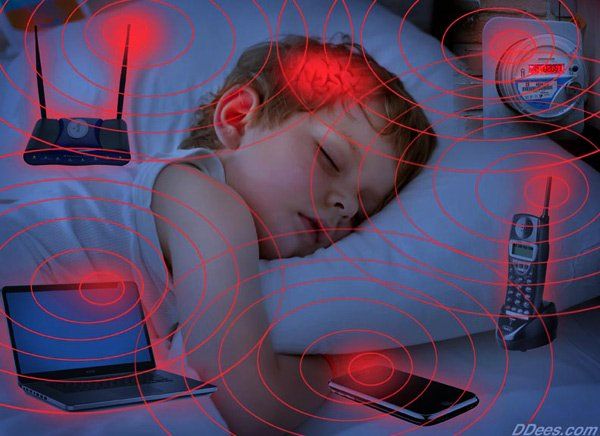
Insomnia? Keep your devices away from your bed.

You don’t need a “digital detox” from information overload, you need a radiation detox. Avoiding smartphone radiation throughout a busy day is difficult to achieve and may disrupt work productivity. But keeping your phone and other devices away from you at night is easy and free, so you can get at least 8 hours of pure regeneration.
Researchers have assumed that smartphones affect people’s sleep due to the purely psychological “proximity effect” or due to blue light before sleep. They have claimed that having your phone next to your bed keeps you thinking about work or social media, causing anxiety, and that radiation itself has no effect on sleep.
But all these psychological negative effects have been produced in laboratory settings by mobile radiation alone, without information distraction (see below). You can easily test this at home: Remove all electronic devices from your bedroom: smartphone, tablet, laptop, router, TV, printer, even LED lights (don’t have a router in your bedroom in the first place and don’t have your bedroom near a smart meter). Place all these devices in another room or as far from your bed as your home allows. A battery powered (no power cable) digital alarm clock costs 10 USD. If your sleep doesn’t improve within a week, you are a rare exception.
Smartphone proximity disrupts cognition
AUSTIN, Texas — “Your cognitive capacity is significantly reduced when your smartphone is within reach — even if it’s off.” That’s the takeaway finding from a 2017 study on 800 participants from the McCombs School of Business at The University of Texas at Austin. Participants perform worse when their phone or anyone’s phone is on a table in front of them as opposed to in another room.
The researchers were interested in seeing what effect smartphone presence has on cognitive performance, so they sorted subjects into three groups:
The “desk” group brought their phones into the testing area and placed them face-down on the desk.
The “pocket/bag” group brought their phones into the testing area but kept them in a pocket or bag.
The “other room” group left their phones in another room before entering the testing area.
All three groups were instructed to place their phones on silent and turn vibrate off, so that no calls, texts, or notifications could distract them during the test.
Once in the testing room, subjects completed a couple of tests designed to measure cognitive performance. Then they answered a questionnaire that asked them how frequently they had thought about their phones during the testing, and whether they thought their phone’s location could have impacted their performance.
The Smartphone Proximity “Brain Drain”
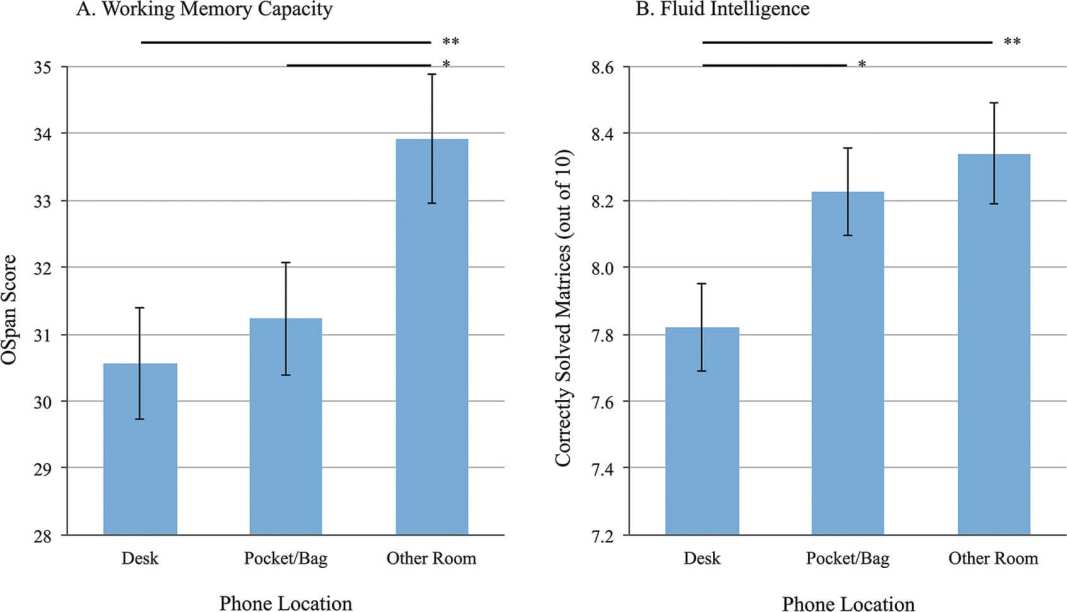
Results of “desk”, “pocket”, and “other room” groups for each of the cognitive tests.
The results were pretty dramatic. The “desk” group performed worst on both cognitive tests, and the “pocket/bag” group came second. In both tests, the “other room” group performed best (12% better than the “desk “group). The results of the cognitive testing strongly suggested that the physically closer our phone is, the worse we perform, even if it’s silenced.
Thinking that perhaps students had been secretly checking notifications, the researchers conducted a similar experiment and asked some students to shut their phones off entirely. But it turned out that didn’t matter – cognitive performance was worst for “desk” students and best for “other room” students even when their phones were turned off entirely.
Perhaps even more significant were the results of the questionnaire: the vast majority of subjects felt that their phone hadn’t impacted their performance, and reported that they hadn’t thought about their phone during the testing period. [1]
Flawed interpretation
Just as in insomnia studies, the researchers in this cognitive study attribute the ‘proximity effect’ solely to psychological mechanisms, distraction by the thought of using the phone. Adrian Ward: “Your conscious mind isn’t thinking about your smartphone, but that process — the process of requiring yourself to not think about something — uses up some of your limited cognitive resources. It’s a brain drain. In other words, when your phone’s easily within reach, some part of your brain has to work to keep you from being distracted by it. That effect is apparently lessened when it’s in a different room and not easily accessible.”
But this interpretation is in no way backed by their own experiments.
Trying not to think about something, and to “use up some of your limited cognitive resources to not think about something” is in itself: thinking.
The fact that mobile proximity lowers cognitive ability also in animal trials, demonstrates that the effect is mostly driven by radiation on the nervous system. Surely the mice in these tests weren’t anxious about missing a social media post by seeing a phone in front of them (see below).
The Texas study could easily have conceived two “phone in the bag” groups:
1: “participants don’t know whether their phone was placed in their bag, it was.” and
2.: “participants don’t know whether their phone was placed in their bag, it was not.”
Given the present results, it can be assumed that the second group, without smartphone present, would score similar to the “phone is in the other room” group.
Your phone doesn’t have some magic telepathic connection to your subconscious mind.
A 2018 study [2] confirmed that memory loss in students is related to the side of the brain at which the phone is usually held.
A replication study by the Swiss Tropical and Public Health Institute found one year of mobile phone is linked to memory damage in teenagers. Specifically, the teens that used the phone against one side of their head scored more poorly on tests that measured memory skills specific to the brain regions getting the highest exposure.
- This is a replication study with double sample size confirming prior results from a 2015 study.
- Higher cumulative RF-EMF brain exposure from mobile phone use over one year was associated with figural memory performance in adolescents.
- Figural memory is mainly located in the right brain hemisphere and association with RF-EMF was more pronounced in adolescents using the mobile phone on the right side of the head.
Previous studies
An earlier study suggests the same mechanism as in the Texas study. Here, University of Maine researchers asked subjects to complete tasks designed to measure cognitive function and attention, with each task further split by difficulty level. Researchers then pretended to accidentally leave either a cell phone or a notebook on the subject’s desk as they took the test.
As you’d expect, the students with phones on their desks performed measurably worse than the students with notebooks. And in a follow-up experiment, the researchers confirmed that this effect held regardless of whose phone it was.
The negative impact of smartphones on learning and cognitive performance has been demonstrated in a number of other recent studies, too.
For example, a 2018 study published in Computers and Human Behavior found that students distracted by their phones remembered less from a short lecture (and performed worse on a subsequent test). A similar study found that students who used their phones during a lecture took worse notes and performed worse on follow-up assessments. Another studyfound that schools which banned mobile phones saw higher test scores post-ban. A Japanese study even found that the physical location of your phone might affect the part of the computer screen you’re most focused on as you work.
Tanil et all 2020 found that the presences of a smartphone and high phone conscious thought affects one’’s memory learning and recall, indicating the negative effect of a smartphone proximity to our learning and memory. [3]
Now, a recent study from August, 2025 proves the devastating long-term effects of smartphones on children.
New research links early smartphone use to poorer mental health in young adults
Summarised by Centrist.
A 2025 global study of over 100,000 young people has found that those who got their first smartphone before age 13 are more likely to face mental health challenges in early adulthood.
These include suicidal thoughts, aggression, feelings of detachment, poor emotional control, and low self-worth. [4]
The research points to early social media access as a major factor, along with risks like cyberbullying, disrupted sleep, and strained family relationships. Lead author Dr Tara Thiagarajan urged policymakers to consider restrictions on smartphone access for children under 13, similar to regulations on alcohol and tobacco.
The study, published in the Journal of Human Development and Capabilities, used a mental health scoring tool to measure well-being. It showed that younger age smartphone ownership correlated with lower scores, with symptoms worsening the earlier children received devices.
While the findings highlight serious concerns, Dr Thiagarajan noted that smartphones and social media are not the sole causes of declining youth mental health. She warned that waiting for absolute proof risks missing the chance to take preventive action.
Some countries, including New Zealand, have already imposed school restrictions on phone use. Experts suggest more education on digital literacy and stricter enforcement of age limits on social media platforms are needed to protect young minds.
Removing Phones from Classrooms Improves Academic Performance
In a 2024 study [5], Sara Abrahamsson, NHH Dept. of Economics, demonstrated that banning smartphones significantly decreases the health care take-up for psychological symptoms and diseases among girls. Post-ban bullying among both genders decreases.
Additionally, girls’ GPA improves, and their likelihood of attending an academic high school track increases. These effects are larger for girls from low socio-economic backgrounds. “Hence, banning smartphones from school could be a low-cost policy tool to improve student outcomes.”
“How smartphone usage affects well-being and learning among children and adolescents is a concern for schools, parents, and policymakers. Combining detailed administrative data with survey data on middle schools’ smartphone policies, together with an event-study design were used in the study.”
A randomised controlled trial involving nearly 17,000 university students revealed:
Classroom observations without smartphones showed “less chatter and distraction, reduced phone use, and more teacher engagement. These results suggest that restricting smartphone use during class can be a low-cost, scalable policy to improve academic outcomes without harming student well-being.” [6] “Mandatory in-class phone collection led to higher grades […] Importantly, students exposed to the ban were substantially more supportive of phone-use restrictions, perceiving greater benefits from these policies and displaying reduced preferences for unrestricted access.”
Oluwafemi et al, 2021 [7] included 44 studies (45 effects) in the analysis yielding a sample size of 147,943 college students from 16 countries.
The results show that smartphone addiction negatively impacts students’ learning and overall academic performance. Further, findings suggest that the greater the use of a phone while studying, the greater the negative impact on learning and academic achievement.
A 2022 review paper [8] found that “overuse of smartphones was found to be related to decrease concentration, working memory and cognitive suppression.” The association between smartphone usage levels and cognitive functions was compared. “The results of this scoping review highlight the need for future research to thoroughly assess the user’s impulse and associated cognitive functions for smartphone use.”
The researchers concluded it will be necessary to consider ways to improve user convenience by developing therapeutic paradigms that can reduce the overuse of smartphones.
Animal studies
In rat studies [9] : “Exposure of microwave radiation frequency showed significant alterations in cholinesterase activity, muscular strength, learning ability and anxiety.”
MWR exposure was also associated with significant alteration in the oxidative defence system and hippocampus degeneration. Histopathological observations clearly depicted the neural degeneration. “Thus, it can be concluded that MWR significantly affects the central nervous system and may lead to many severe illnesses. This study may reveal a platform to understand its toxic effect and can further be used for amendment in current guidelines of mobile radiation.”
Surely, the rats weren’t anxious to check their social media feed. Rather, they were just being fried with mobile phone radiation.
In 2020: Swiss albino male mice (n = 30) were randomly categorized into 3 groups; control, 40 min, and 60 min exposure to 2400 MHz radiofrequency electromagnetic radiation (RF-EMR) daily for 60 days. [10]
In exposed mice compared to control mice, a significant increase in anxiety-like behavior has been observed. Histological observations have shown many black and dark blue cytoplasmic cells with shrunken morphology degenerative alterations in the neuronal hippocampus in the radiation exposed mice.
“Our findings suggest that 2400-MHz RF-EMR cell phone radiation affects the structural integrity of the hippocampus, which would lead to behavioral changes such as anxiety., “This alerts us to the possible long-term detrimental effects of exposure to RF-EMR.”
Stupid AND fat?
Mobile Phone Radiation Deflects Brain Energy Homeostasis and Prompts Human Food Ingestion
25 min of RF-EMFs were emitted by two different mobile phone types vs. sham radiation under fasting conditions. Spontaneous food intake was assessed by an ad libitum standard buffet test.
Exposure to both mobile phones strikingly increased overall caloric intake by 22–27% compared with the sham condition. [11]
[1] Dataquest; The Phone Proximity Effect: Your Phone Could Be Sabotaging Your Studies; February 7, 2019:
[2] Foerster M, Thielens A, Joseph W, Eeftens M, Röösli M. A Prospective Cohort Study of Adolescents’ Memory Performance and Individual Brain Dose of Microwave Radiation from Wireless Communication. Environ Health Perspect. 2018 Jul 23;126(7):077007. https://doi.org/10.1289/EHP2427
[3] Tanil CT, Yong MH. Mobile phones: The effect of its presence on learning and memory. PLoS One. 2020 Aug 13;15(8):e0219233. https://journals.plos.org/plosone/article?id=10.1371/journal.pone.0219233
[4] Thiagarajan, T. C., Newson, J. J., & Swaminathan, S. (2025). Protecting the Developing Mind in a Digital Age: A Global Policy Imperative. Journal of Human Development and Capabilities, 26(3), 493–504. https://doi.org/10.1080/19452829.2025.2518313
[5] Abrahamsson, Sara, Smartphone Bans, Student Outcomes and Mental Health (February 22, 2024). NHH Dept. of Economics Discussion Paper No. 01, Available at SSRN: https://ssrn.com/abstract=4735240 or http://dx.doi.org/10.2139/ssrn.4735240
[6] Sungu, Alp and Choudhury, Pradeep Kumar and Bjerre-Nielsen, Andreas, Removing Phones from Classrooms Improves Academic Performance (July 25, 2025). Available at SSRN: https://ssrn.com/abstract=5370727 or http://dx.doi.org/10.2139/ssrn.5370727
[7] Oluwafemi J. Sunday, Olusola O. Adesope, Patricia L. Maarhuis, 2021:The effects of smartphone addiction on learning: A meta-analysis,; Computers in Human Behavior Reports, Volume 4, 2021,
https://www.sciencedirect.com/science/article/pii/S2451958821000622?via%3Dihub
(https://www.sciencedirect.com/science/article/pii/S2451958821000622)
[8] Yoo, In-Gyu & Do, Ji-Hye. (2022). Exploring the link between smartphone overuse and cognitive decline: a scoping review. Family Medicine & Primary Care Review. 24. 92-99. https://doi.org/10.5114/fmpcr.2022.113022
[9] Sharma A, Sharma S, Shrivastava S, Singhal PK, Shukla S. 2019: Mobile phone induced cognitive and neurochemical consequences. J Chem Neuroanat. 2019 Dec;102:101684.
https://doi.org/10.1016/j.jchemneu.2019.101684.
[10] Imam Hasan, Mir Rubayet Jahan, Md Nabiul Islam, Mohammad Rafiqul Islam, 2022: Effect of 2400 MHzmobile phone radiation exposure on the behavior and hippocampus morphology in Swiss mouse model, Saudi Journal of Biological Sciences, Volume 29, Issue 1, 2022, https://doi.org/10.1016/j.sjbs.2021.08.063.
(https://www.sciencedirect.com/science/article/pii/S1319562X21007518)
[11] Wardzinski EK, Jauch-Chara K, Haars S, Melchert UH, Scholand-Engler HG, Oltmanns KM. Mobile Phone Radiation Deflects Brain Energy Homeostasis and Prompts Human Food Ingestion. Nutrients. 2022 Jan 14;14(2):339.





 ABRUPT EARTH CHANGES
Leave a comment