Did the unexplained, extreme Nitrogen Dioxide levels in northern Italy contribute to Corona-related respiratory illness?
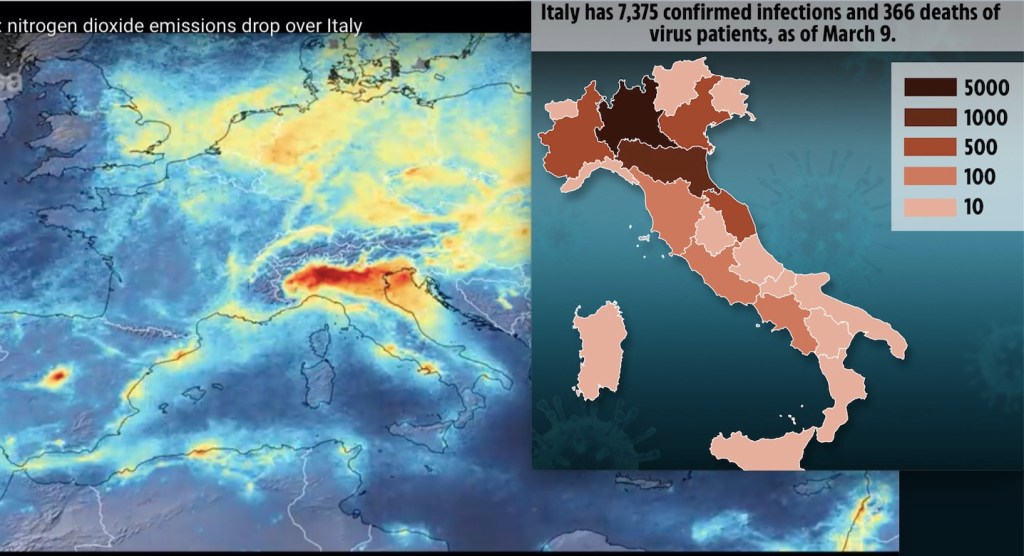
Northern Italy is the epicenter of the Coronavirus pandemic in Europe. As of March 9th, the highest rates of positive test results and patients with flue-like symptoms and acute respiratory illness attributed to COVID-19 are in the provinces of Lombardy, Veneto and Emilia, roughly: the Italian Po Valley. At that date Italy, had quarantined 16 million people in the country’s north.
“The country has 7,375 confirmed infections and 366 deaths of virus patients – one of the most severe outbreaks outside of China.” Italy is now in lock-down.

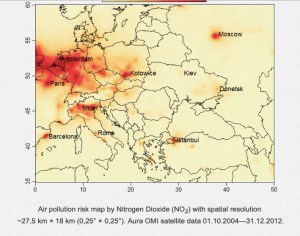
Newly released ESA images show extreme and unexplained concentrations of Nitrogen Dioxide (NO2) levels throughout the Po Valley in January and February, far exceeding the rest of Europe. The NO2 levels started to drop to average values in March.
The emission cloud even reached out into the Adriatic Sea, whereas at any other source, NO2 does not cause a tail in the westward direction of the prevailing wind (According to NOAA, “NO2 is a pollutant with a relatively short atmospheric lifetime, so it does not get transported far from its source.”)
“Nitrogen dioxide inflames the lining of the lungs, and it can reduce immunity to lung infections. This can cause problems such as wheezing, coughing, colds, flu and bronchitis.”


Here is an ESA measurement showing normal NO2 levels in Europe recorded between April and September 2018:

ESA: “Based on measurements gathered by the Copernicus Sentinel-5P mission between April and September 2018, the image shows high levels of nitrogen dioxide in London, Paris, Brussels, western Germany, Milan and Moscow. Nitrogen dioxide pollutes the air mainly as a result of traffic and the combustion of fossil fuel in industrial processes. It has a significant impact on human health, contributing particularly to respiratory problems.”
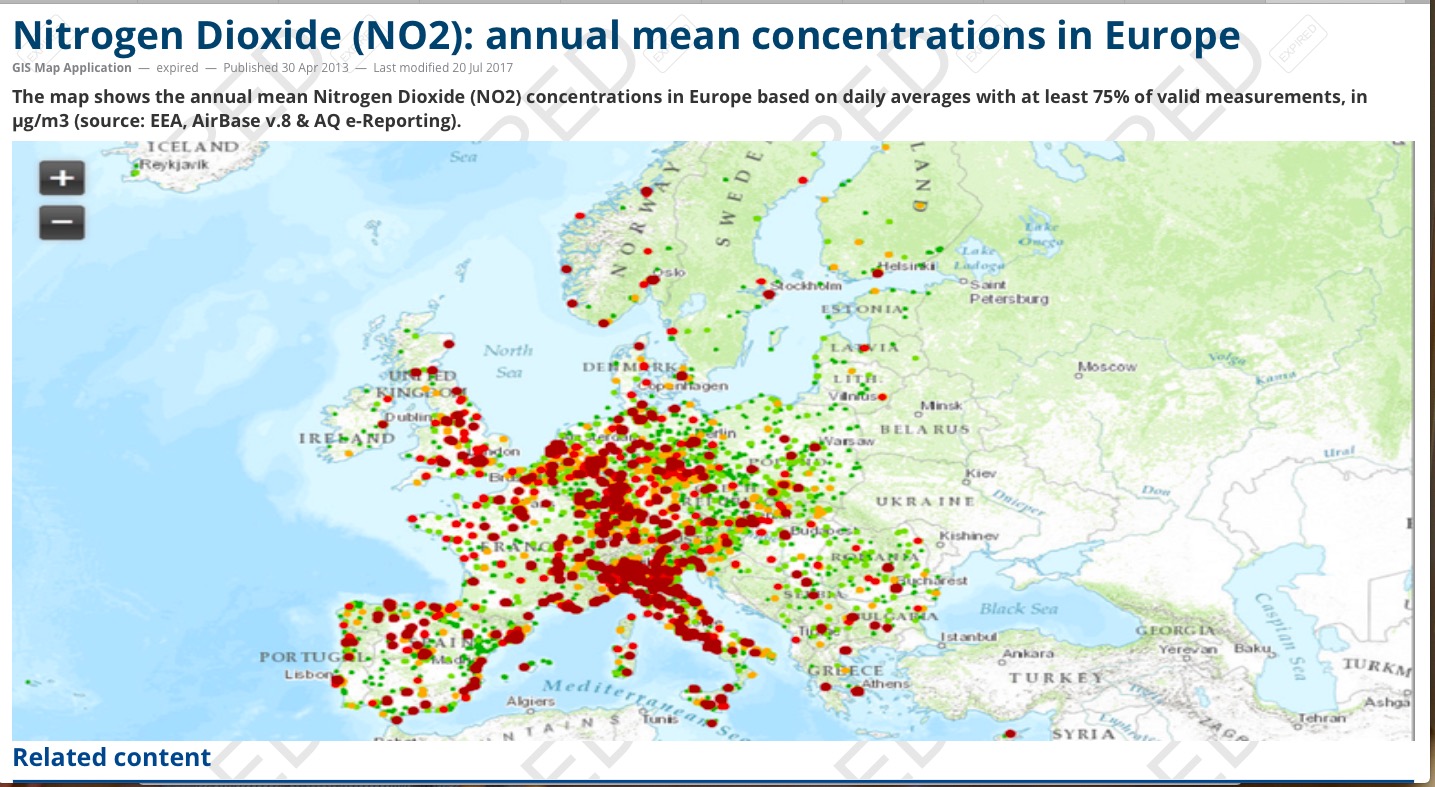
Here are the NO2 annual mean concentrations in Europe as of 2017. Note there is little difference between Northern Italy and Rome/Naples or Western Germany/ Netherlands.
Somewhat clumsily, ESA is now unraveling the story from the other end: saying that NO2 in Europe has dropped as a result of the Coronavirus, as people are forced to stay home and industry and traffic is shut down, which is indirectly true. But the shutdown of Europe does not explain why NO2 concentrations were unprecedented in northern Italy in January and February as compared to the rest of Europe.
Living in Central Switzerland, just across the Alps from Milan, many people have told me they had a dry cough and a sore throat for a few days in recent weeks and they wondered if they could have had a low-symptom case of Coronavirus. (80% of the infected have no symptoms). I was in the Alps several times in the past few weeks and noticed a smell of ozone, causing a sore throat. In Switzerland, noticeable ozone concentrations are normally limited to hot summer days in the cities.
The question is now: Where did the extra Nitrogen Oxide in these extreme concentrations originate from? It cannot be from traffic, for this, northern Italians would have to be driving several times as much as usual in the months of Jan and Feb.
Could there even be a natural contributor? “NO2 is also introduced into the environment by natural causes, including entry from the stratosphere, bacterial respiration, volcanos, and lightning.” The Po Valley is an earthquake region, but has only extinct volcanoes in the East and sources of radon gas. Heavily affected Iran is also a highly active seismic region.
The theoretical introduction from the stratosphere is intriguing in the context of the next Grand Solar Minimum and the unprecedented low solar activity of the recent years, and will be further investigated and published in future posts.
It should be pointed out that Moscow had slightly elevated NO2 concentrations at the same time, but few Corona cases are officially reported from there. In the Wuhan region, during the Corona crisis, NO2 did not seem to be abnormally high.
Stay save and don’t forget your daly Mineral /Vitamin supplements (all in one or A-Z).
Here are a few additional notes on NO2:
From Wikipedia: “For the public, chronic exposure to NO2 can cause respiratory effects including airway inflammation in healthy people and increased respiratory symptoms in people with asthma. NO2 creates ozone which causes eye irritation and exacerbates respiratory conditions, leading to increased visits to emergency departments and hospital admissions for respiratory issues, especially asthma.”[29]
“For the general public, the most prominent sources of NO2 are internal combustion engines burning fossil fuels.[8] Outdoors, NO2 can be a result of traffic from motor vehicles.[17] Indoors, exposure arises from cigarette smoke,[18] and butane and kerosene heaters and stoves.”[19]
“Workers in industries where NO2 is used are also exposed and are at risk for occupational lung diseases, and NIOSH has set exposure limits and safety standards.[6] Astronauts in the Apollo–Soyuz Test Project were almost killed when NO2 was accidentally vented into the cabin.[16] Agricultural workers can be exposed to NO2 arising from grain decomposing in silos; chronic exposure can lead to lung damage in a condition called “Silo-filler’s disease“.[20][21]
Historically, nitrogen dioxide was also produced by atmospheric nuclear tests, and was responsible for the reddish colour of mushroom clouds.[22]
As stated above, the western Po region is prone to radon gas emission from the ground. However I have not found evidence for elevated radon levels at the beginning of 2020.
“Radon is a naturally occurring radioactive gas. It’s produced when uranium, thorium, and radium break down in soil, rock, and water. It’s then released into the air. Radon is odorless, tasteless, and invisible.
Radon can accumulate in some places where ventilation is inadequate, such as in an underground mine. It can also build up inside buildings. Long-term exposure to high levels of radon can be dangerous to your health.
Radon exposure symptoms
- persistent cough.
- coughing up blood.
- shortness of breath.
- chest pain, especially when you cough or laugh.
- frequent infections such as bronchitis and pneumonia.





 ABRUPT EARTH CHANGES
Leave a comment